
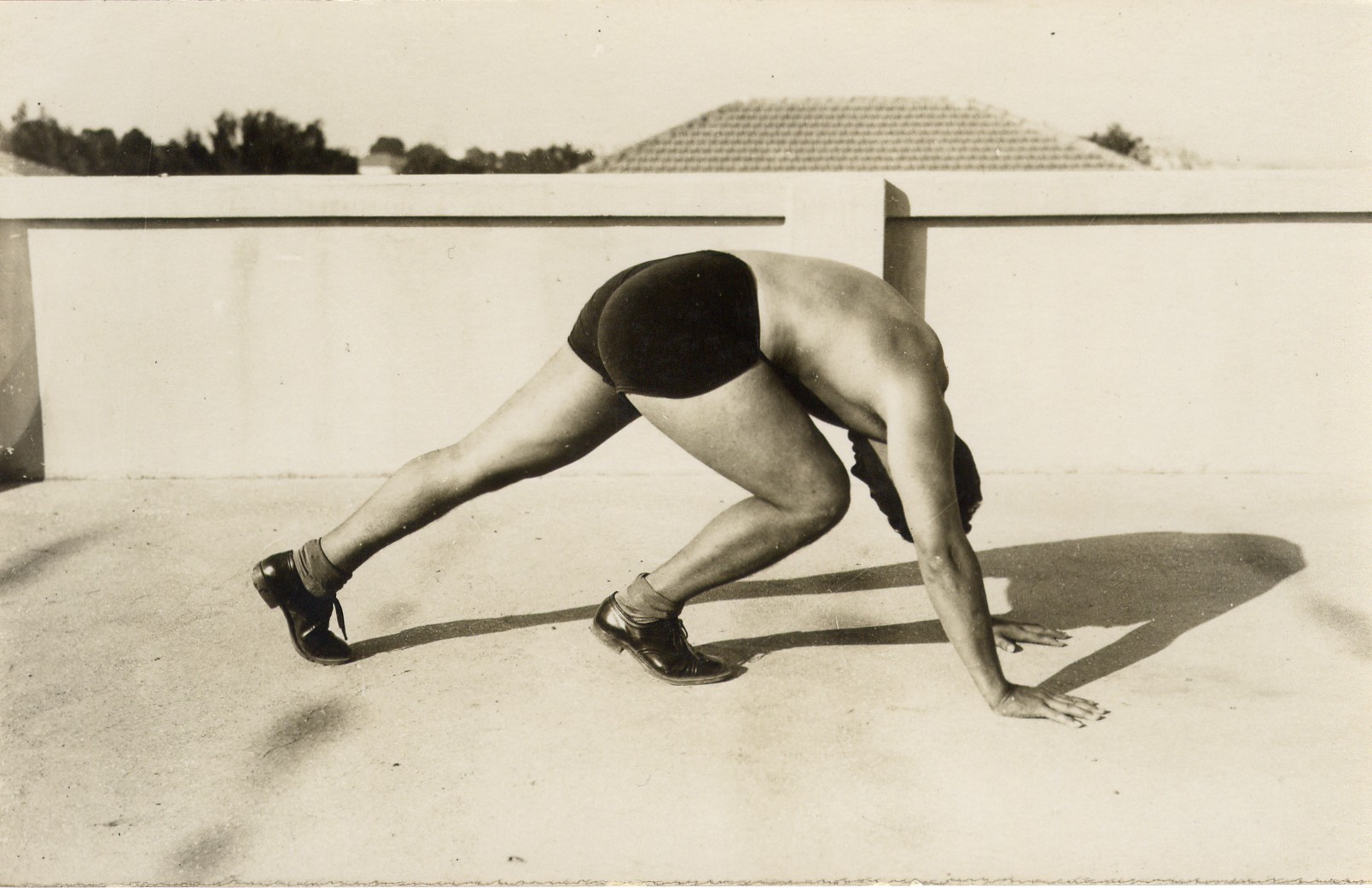
Have you ever seen a Feldenkrais practitioner do a Judo roll? When you observe a Feldenkrais lesson, you would likely see someone lying in relation to the ground, using slow movements and directed attention to improve their own self-use. What you wouldn’t necessarily see, unless your eyes had been trained to look for it, is the rich martial arts culture that informed Moshe Feldenkrais as he created his Awareness Through Movement® lessons. In one of the method’s more dynamic sequences, you start on all fours and learn how to take your arm underneath you as preparation for the movement of a Judo roll.
Moshe Feldenkrais, a Judoka
Moshe Feldenkrais was one of the first authorized western teachers of the art of Judo, and he was involved in the opening one of the first Judo schools outside of Japan, in Paris, France between 1935 & 1936. Feldenkrais worked in tandem with Mikinosuke Kawaishi to establish the Judo Club de France, systematically translating the traditional Japanese practice of Judo through the lens of a western physicist and engineer. This process helped to make the art form more accessible to the western mind, a philosophy he detailed in his book, Higher Judo that he worked on while studying with Gunji Koizumi while in London in the late 1940s.
“Dr. M. Feldenkrais has made a serious study of the subject, himself attaining Black Belt efficiency. He has studied and analysed Judo as a scientist in the light of the laws of physics, physiology and psychology, and he reports the results in this book which is enlightening and satisfying to the scientific mind of our age.” – Moshe Feldenkrais – Higher Judo – Forward by G. Koizumi
The Turning Point: Injury and Insight
Feldenkrais continued to practice Judo throughout the 1940s, but eventually he began to transition away from his combat focus. One of the potential catalysts for this change was a serious knee injury, initially occurring in 1929 while playing soccer, which left him rehabbing for six months.
Then, during his work for the British Admiralty during WW2, Feldenkrais spent many hours on submarines researching sonar technology. It was under these precarious, turbulent conditions that he reinjured his knee. While consulting with medical specialists, he was given a 50/50 chance of being able to walk after what was considered a necessary surgery. Feldenkrais declined the surgery, choosing instead to try and find solutions through self study.
This period of his life offers an interesting metaphor for his later work. Just as sonar used sound waves to illuminate the unknown, Feldenkrais would later use directed attention to illuminate our internal organization. This was a turning point in his own life. Being an engineer, he took the philosophies he had learned through self defense, turned them inward, and used them as a tool for self knowledge. Much like how sonar eventually evolved into pre-natal ultrasound, a tool for supporting life rather than causing destruction.
Judo’s Core Philosophies
Let’s look at the core philosophies behind the practice of Judo, as set out by its founder Jigoro Kano, which can be translated into Feldenkrais’s development of somatic education.
Ju no Ri (柔の理): The Principle of Gentleness or Yielding: Often translated as “the gentle way,” Ju does not mean weakness; it means non-resistance and adaptability.
By practicing “yielding” – slowing down and working with your personal limitations rather than fighting them – you allow the nervous system to let go of its protective contraction naturally through curiosity and exploration.
Seiryoku Zen’yo (精力善用): Maximum Efficiency, Minimum Effort: Kano defined this as the optimal use of energy to achieve any objective.
In Awareness Through Movement lessons we begin to organize movement so that weight and force travel through the bones. This process helps develop highly coordinated movement across our whole body and frees our muscles for effective action. Feldenkrais believed that true health is a state of physical efficiency where no energy is wasted on parasitic, unconscious muscular contraction and you are fully available for action.
Jita Kyoei (自他共栄): Mutual Welfare and Benefit: Kano believed that self-perfection is meaningless unless it elevates the community around you.
When we reduce our chronic pain and restore our natural autonomy, we change how we interact with the world. A well-organized, pain-free human is naturally more patient, present, and supportive of those around them.
Mature Behavior and Effective Action
For Feldenkrais, Judo was one of the foundations for the development of his method. From it he learned that human maturity is the evolution from unconscious reflex to conscious choice.
“The essential aim of Judo is to teach, help and forward adult maturity, which is an ideal state rarely reached, where a person is capable of dealing with the immediate present task before him without being hindered by earlier formed habits of thought or attitude.” – Moshe Feldenkrais – Higher Judo – Introduction
A “mature” person possesses the self awareness to “pause” between stimulus and response, choosing the appropriate action rather than being dictated by an unconscious impulse, and then being able to act on that choice without internal resistance.
The other aspect of Judo that Feldenkrais saw clearly as a key to effective human movement was coordinated whole body action, in any direction. He understood that when we are fully available for movement, and can produce a coordinated response to our environment, we are at our most effective.
“We have seen that the proper manner of physical action is such, that the lower abdomen is the origin of movements of the body, or more precisely, the point that moves the least relatively to the ground, at the crucial moment of any throw; it is the first to move at the beginning of any movement of the body. The fundamental reason for this, is that the dynamic economy demands that the heavier masses should move up and down as little as possible. The lighter parts of a freely moving body when rotating, describe more extensive trajectories than the heavier ones. ” – Moshe Feldenkrais – Higher Judo – Where We Start and Why
The Fear of Falling
In parallel with writing his book on Judo, Feldenkrais was developing his ideas on human psychology and health to present them to the scientific community. In Body and Mature Behavior: the study of Anxiety, Sex, Gravitation and Learning he presented some of the lessons he learned from Judo within the context of human psychology and how fear and compulsion create a reduced expression of human potential.
In that paper Feldenkrais points out that the fear of falling is one of our only innate, unconditioned fears. Before life teaches us complex anxieties, our nervous system instinctively panics when it loses equilibrium. Left unchecked, this quiet fear of gravity turns into chronic physical contraction – a subtle, lifelong habit of holding ourselves up away from the floor. This is very common in the modern world which favours sitting on chairs instead of being able to transition easily between standing and sitting on the floor.
This is where his scientific writing directly intersects with Judo. The very foundation of Judo is Ukemi – the art of falling safely. Judo doesn’t fight gravity; it teaches you to yield to it, roll with it, and land without panic.
Feldenkrais took this exact lesson and stripped away the impact of martial practice. Most of us go through life avoiding our relationship with gravity, treating the ground beneath us like a foreign world. By allowing the nervous system to trust itself during its interaction with the floor we can start to let go of the reflex of contraction from an unconscious fear of falling.
Combat, Stress and Learning
When you’re facing an opponent on the mat, your nervous system steps into high alert. In that survival state, instinct and compulsive reflexes often take over to protect you. While necessary for combat, high stress actually narrows our options and reduces our availability for learning – it takes us back towards rigid, protective habits.
Feldenkrais realized that while fighting arts build speed and power, genuine human learning – changing old habits and creating new possibilities – doesn’t happen while the nervous system is in a state of alarm.
Without that stress the nervous system can quieten down enough to actually feel what it’s doing, thereby increasing your availability for learning. You move away from defensive compulsion, creating the space for exploratory learning and personal change. By removing the opponent what remains is just you and the mat.
Conclusion
We no longer live in a world where the primary daily challenge is physical survival (for many, but not all of us), yet the lessons embedded in martial art practice remain relevant. In his creation of the Feldenkrais Method® of somatic education, Moshe extracted some of those insightful universal truths of human movement and brought them into the realm of health, somatic education and self knowledge.
By removing the immediate imperative of combat, he discovered that what remains is a practice of human freedom and ideological maturity.
Feldenkrais’s method teaches us that by lowering the nervous system’s alarm state, we can unlearn the unconscious contractions born of gravitational anxiety and physical / psychological threat. In that learning environment we can refine our self perception so that when we act, we do so not from compulsive reflex, but from genuine choice, moving in the direction of action that is both effective and efficient.
Feldenkrais’s own journey represents a fundamental shift in orientation, much like the evolution of sonar – which moved from a tool of wartime detection to one of life-saving medical insight. He took the mechanics of self-defense and turned it inward to reveal our biological potential. He took the philosophies of martial practice and used them to build his unique approach to educating healthy and effective human beings.
Judo therefore holds an important place in the legacy of the Feldenkrais Method.
Next time you get on the mat for a Feldenkrais lesson, remember some of these principles and use them to help you in your journey towards self knowledge and effective action, and maybe even try the judo roll lesson?
Personal Reflection: A Historical Parallel in Taiji Quan
For full transparency, while I am a qualified Feldenkrais practitioner, I am by no means an expert on Judo, having only taken classes as a ten-year-old, and then having six months of one-to-one Jiu-Jitsu tuition when I was sixteen. I do however have some experience with martial arts having practised Taiji Quan (Tai Chi Chuan) for over twenty years.
There is an interesting parallel to be drawn in the direction of Taiji Quan to Moshe Feldenkrais’s own transition from Combat to Somatic Education.
Taiji Quan was a closely guarded martial art, where only family students had access to the full depth of its teachings. The reason for this was that it was a profession as well as a means for personal and familial defense. Its masters were employed as highly paid bodyguards, estate or goods transport protectors, and tactical trainers for militaries. However, during the early 1900s, the world had begun to change, modern firearms and industrialized warfare rendered traditional hand-to-hand combat systems practically obsolete and the market for professional bodyguards vanished.
In this context a meeting was arranged between the various heads of the different Taiji families, Yang, Wu, Sun and Li, and the future of Taiji Quan was discussed. It was agreed that a slower, less combat focused Taiji Quan would be created, that would serve primarily as a health practice, and in this way, this rich and profound practice would be preserved and passed on to new generations.
 Joe Webster
Joe has spent over 20 years training in Taiji Quan (Tai Chi Chuan), Meditation (various systems) and a form of Qi Gong called Taijiwuxigong, all of which are rooted in the spiritual philosophies of the east (Buddhism and Taoism) and work towards balanced mental and physical states.
Joe also trained in Jiu-Jitsu, Judo and Karate in his youth and has a grounded understanding in the martial side of movement practices.
He studied Anthropology at University College London and has since developed keen interests in human evolution, neuroscience, and the traditional practices (religious/medical) of many cultures.
However it was through his search for solutions with his own set of habits and constraints that he came across the Feldenkrais Method which seemed to provide practical solutions to his experiences with anxiety, and offered him a way to begin unwinding some of the unconscious habits that had helped in creating it.
Joe completed a professional Feldenkrais training in London between 2016-2020 and now lives and works in Bristol, UK. He also works with the Feldenkrais Guild of North America as part of their communications team, and serves as the editor for their public (SenseAbility) and practitioner (In Touch) newsletters.
Joe’s Website: Self Knowledge