
The first time a bubbly, joyful feeling rose through me like a reflex, I was lying on the floor doing what looked like almost nothing.
I laughed out loud as my body moved in a new, unexpected way, and delight just… surprised me.
Feldenkrais is like if exercise and meditation had a love child. In these lessons, a teacher guides you through slow, almost suspiciously simple movements with deep, curious attention. Moshe Feldenkrais, an engineer and martial artist who created this work to recover from a serious knee injury, believed awareness held some kind of secret sauce—and I’m starting to believe him. Where we put our attention seems to have a healing quality, like putting salve on a wound.
These classes are slow. I mean really slow. Sometimes boring. I often start out annoyed.
Five minutes in, I’ve already checked the clock.
Surely, I think, we must be halfway through. We are not.
There is a discomfort for me in moving this slowly, especially for a system accustomed to urgency. I am a college professor with adolescent, highly-involved children. My days are full, fast, and moving. It is somehow easier for me to schedule a brisk, efficient workout or walk than it is to find time to be on the floor and do less. The slowness asks something of me that productivity never does. It asks me to be present and notice what is going on now, not rehash the past or strive toward the future. It asks me to be present and move simply and with attention.
How can something so simple a baby can do it, be so hard for me?
Staying in the lesson has been difficult on a number of occasions.
Sometimes the movements feel too small to matter. Sometimes I wonder if I’m doing them “right.” Sometimes my attention drifts, or I find myself subtly trying to improve the movement rather than sense it. The simplicity can feel almost suspicious – how could something this minimal be doing anything at all?
And yet, if I linger – if I don’t leave – the movement changes. I change.
It becomes easier. Quieter. Almost automatic, like a child swinging higher without trying, giggling as their body has become the arc of the swing itself, the fulcrum doing the work. I remember learning about simple machines in science class. It’s only recently that I’ve started to realize and see how our complex bodies can move with this type of pure efficiency as well.
As I notice my small movements, I’m struck again and again by their quality – how the tiniest push from one little muscle can wing its way through my whole body, like wind through a kite’s ribbon. To be that pliable, that relaxed requires effort in the same way natural child birth requires it. Work isn’t even the right word, but to relax as the fierce energy of a contraction surges through you like a tidal wave is its own kind of mental and physical thing (for lack of a better word). I notice and soften muscles I didn’t know I’d been bracing. Because of Feldenkrais, I’ll notice in line at a checkout counter that – oops, there I am clenching my glutes again for no good reason. Back on the floor in class, I notice my spine feels less like a hinge and more like a figure eight, oscillating like a river.
Sometimes, I feel dissolved in the movement.
But sometimes, something else happens that I haven’t told many people about.
In one of my first classes, tears came immediately. A release in my left hip. Pain in my knee. I found myself placing a hand there, instinctively, not to fix it but to offer something like kindness. I had to stop – twice – before continuing. The movements were so small, and yet what they stirred felt anything but. It had opened my system up to something I’d been holding deeper than conscious thought.
Afterward the release and energy that moved through during the class, I slept deeply, unexpectedly. When I woke, the world looked different. Not in a dramatic, cinematic way – but my eyes seemed to register more. More light. More detail. More presence.
At the beginning and end of the lessons, I lie on my back and sense the parts of my body that meet the floor. It’s like listening for sensation. And somehow, after my Zoom class, the surface area my shoulder seems to occupy is different. Not looks different. Not should be different. Is.
And even though I love this broadening of sensation, this too has been disorienting at times.
How can perception shift so wildly? What does it mean to trust a change that is felt but not seen? What is me? Where do I begin and end? These seem philosophical – but for me they are physical questions.
Sometimes being a Feldenkrais student feels like waking up sections of myself that have been on mute – maybe from my odd traumatic birth experience, where my left leg required early intervention, or maybe from my years in a scoliosis brace, maybe just from being human in a tense world.
At times, it feels as if my entire left leg is filled with sadness – like I am pouring a little off the top, again and again. Like there is a gray cloud out beyond my body to the left. Attention changes the cloud – its shape – sometimes its story – often what moves through me. Again, attention is doing something.
Feldenkrais, for me, has not only been subtle. It has also been activating.
There are moments of shaking, or sudden waves of emotion. Yawning, breath shifts, unexpected sounds I have to make, cries – that if I just allow them to come – sound like a baby. This is not work I feel comfortable doing in the presence of others, but if I can just let the sensations come through and respond, I am amazed repeatedly at the wisdom in these bodies of ours. At times it will lead to pressure-pointing myself or shifting into yoga poses and stretches that I do not intellectually know, but somehow my body knows. For a farm girl who is also trained as a skeptical academic, I’m not sure that I’d believe any of this if it weren’t my own human experience. Because I am practicing remotely – living in rural Nebraska, working over Zoom with a teacher a state away – I often find myself in a strange contrast: my camera off, my body moving through something intense, while on the screen others appear still, quiet, serene.
I sometimes feel alone in it, but I don’t feel lonely.
The slowness, which eventually becomes comforting, can first feel unsafe.
For a nervous system shaped by urgency, or by early constraint, stillness is not immediately calming. It can feel like exposure.
And yet, if I stay – if I ride the wave of what is arising – something reorganizes.
I am not doing this work alone.
There is something important in being guided by a voice that does not rush. My teacher’s pacing, her tone – steady, spacious, almost reminiscent of Mr. Rogers – creates a sense of being held without being handled. It allows me to return, again and again, even when I drift or resist or need to let something intense move through my system.
One lesson had me lying on my side, attempting to bring my bent leg into a standing position on my foot. The first time, nothing. The second, still nothing. It felt as if the signal simply did not exist.
And then, on the third attempt, something came online.
A part of my body – somewhere deep in the back of my hip – engaged, and the leg moved. Not forced. Not willed. Organized. So, it’s not like it’s all been challenging. So much of it has been enlivening.
It is a wild experience to encounter a movement you cannot do, and then suddenly can.
Another day, on my stomach, sliding my knee like a baby learning to crawl, the sequence moved from awkward… to boring… to unexpectedly fun. Again, not something I decided. Something that happened. I was giggling alone on the floor of my sunroom at how fun it all was, primal, instinctual, pure play.
Less top-down. More bottom-up.
A friend told me that movement can offer some of the same benefits people get from antidepressants. And someone once said that if we didn’t need to move, we wouldn’t need a brain. That idea continues to rearrange the furniture of my mind, pushing at what it means to think, to feel, to be.
For me, other modalities have played a role as well. Practices like TRE and Somatic therapy have helped discharge intensity – while Feldenkrais seems to offer something different. Not release, exactly, but integration. Grounding. Re-patterning.
I feel, quite literally, reorganized.
There are muscles in my hip, trunk, and back that haven’t been online since middle school – shifting from patterns that were protective, perhaps even necessary once, into ones that are more responsive, more adaptable, more mushy and strong.
People have commented that I am walking differently. I feel it too. Standing more upright. Sensing more of myself, moving less like the Tin Man from The Wizard of Oz.
That increased “surface area” I notice on the floor has followed me into daily life. I sense more of myself in three dimensions in how I walk, move and experience the world.
And perhaps most surprisingly, I am beginning to feel more comfortable and cozy as a body. Not in it – as it.
Recently, I had the experience of an emotion rising while I was in a public place, and instead of immediately overriding it, I was able to pause, sit, allow a small expression – and then return to regulation. Not perfectly. Not dramatically. But differently than I had before. This doesn’t have to do with Feldenkrais and yet it has everything to do with it. We are learning to move physically -and also how to move through life.
For me, the real work in all of it is being curious, paying attention. Listening to the interior felt sense, allowing, responding.
Trying softer. Finding the easier route to movement and letting the rest just be as I try to relax, along for the ride. It takes practice to be at ease in my own human body. As weird as that sounds, it’s the truth.
This is all so different from the movement experiences I’ve had throughout life – those shaped by performance, improvement, endurance, and athleticism. I was a college athlete, a volleyball player, so I thought I knew what there is to know about moving my body, about pushing it to its limits. It is wild to me that some of the “answers” my physical body was seeking have less to do with pushing, and more to do with listening and responding. This is not about achieving a form, but sensing a process. Not about pushing, but allowing and being with what sensations arriving now and letting anything that feels old or stagnant or high-voltage find its way through or fade away.
It feels, in some quiet way, like being reorganized into more of myself, reminded that less is required to be me and walk on this Earth.
And sometimes, in the middle of it, joy rises up – bubbly, sparkly, alive.
And I laugh. Out loud. Alone on the floor.
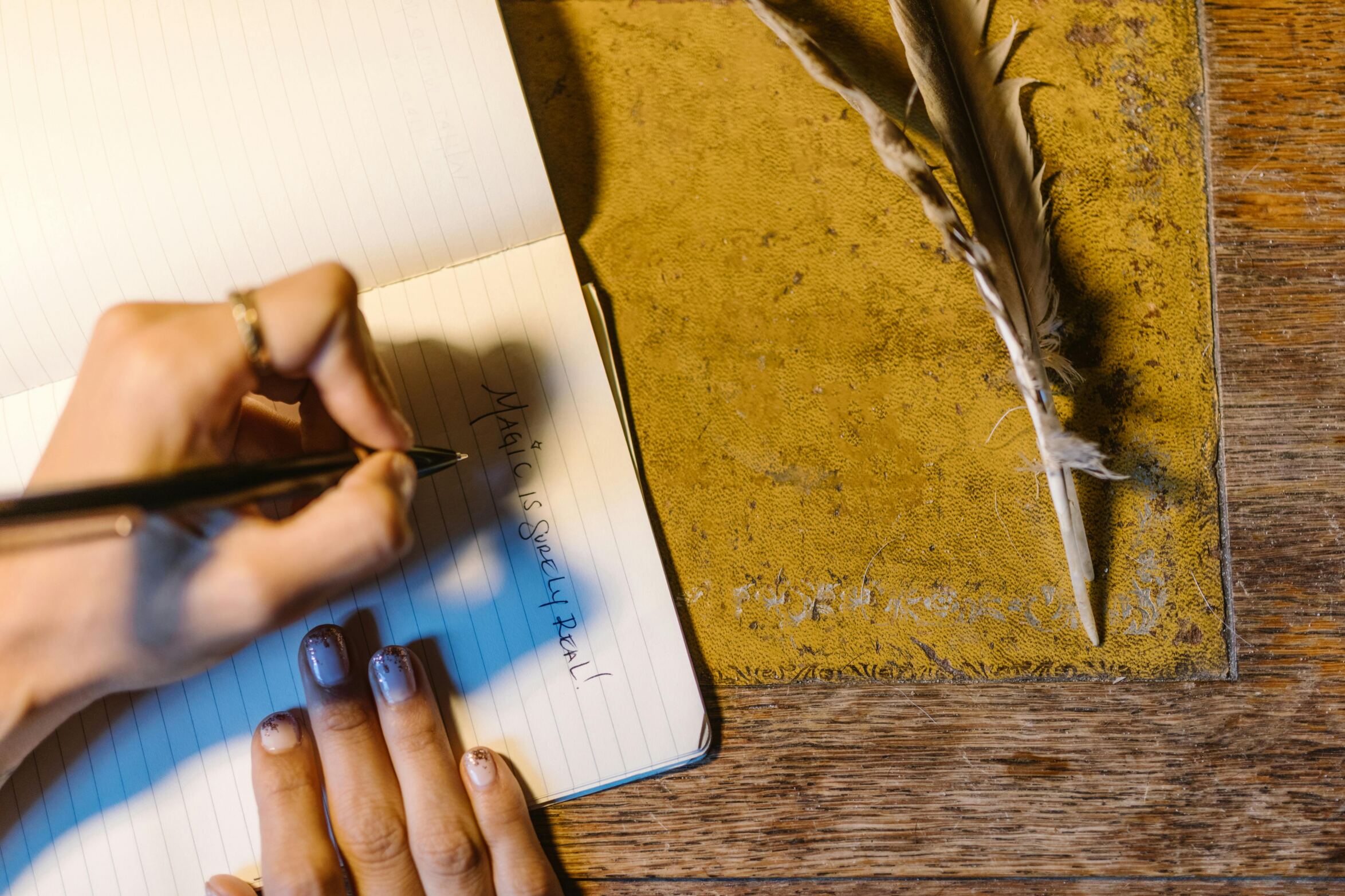
My notebook still says: What magic is this?
I’m not sure I need to answer that.
But I am grateful to be, as the famous poet Rilke says, living the questions, trying to embody them.
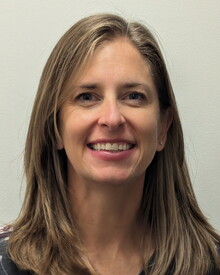 Evi Wusk is an Assistant Professor of Education and English at Nebraska Wesleyan University in Nebraska, USA. With 20 years in K–16 education experience, she is a writer and speaker who loves storytelling and connecting, especially with her students. You can follow her writing at her Substack: Somatic Sparkle and on her blog eviwusk.com